When the Bubble meets the Pin

My previous blogs have discussed individual asset bubbles and their impact on the economy. But what if there’s something bigger on the horizon? What if there’s an all-encompassing, all-growing bubble? And what if that bubble is on the verge of popping? Let me present: The Everything Bubble.

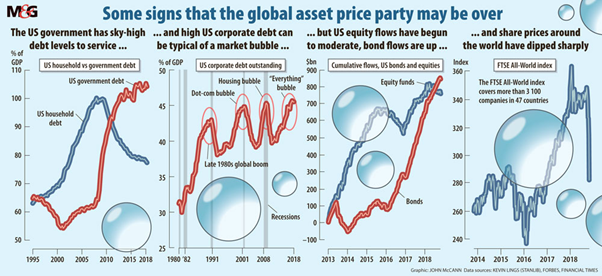
First coined in 2015, the “everything bubble” is an economic bubble of all major asset classes. In the US, it includes the rising student, national and corporate debt (Mauldin’s info-graphic depicts the inter-linking elements that make up this bubble). Financial analyst Jesse Felder suggests the cause of this bubble is that everything is overvalued; prices in the stock market, housing market and even in distinctive collectible markets have sky-rocketed to epic proportions. Everything appears to be in a bull market.

Similarly, Jesse Colombo makes reference to the Wall Street stock bubble being led by FAANG (Facebook, Apple, Amazon, Netflix and Google). Since 2009, these companies have projected figures upwards of 1000%, with Netflix seeing the biggest growth of over 6000%.
For years the solution to these rising problems in the economy have been two things: the policy of creating trillions in new currency and buying trillions in assets. As a result, Federal borrowing has now reached $1.2 trillion.

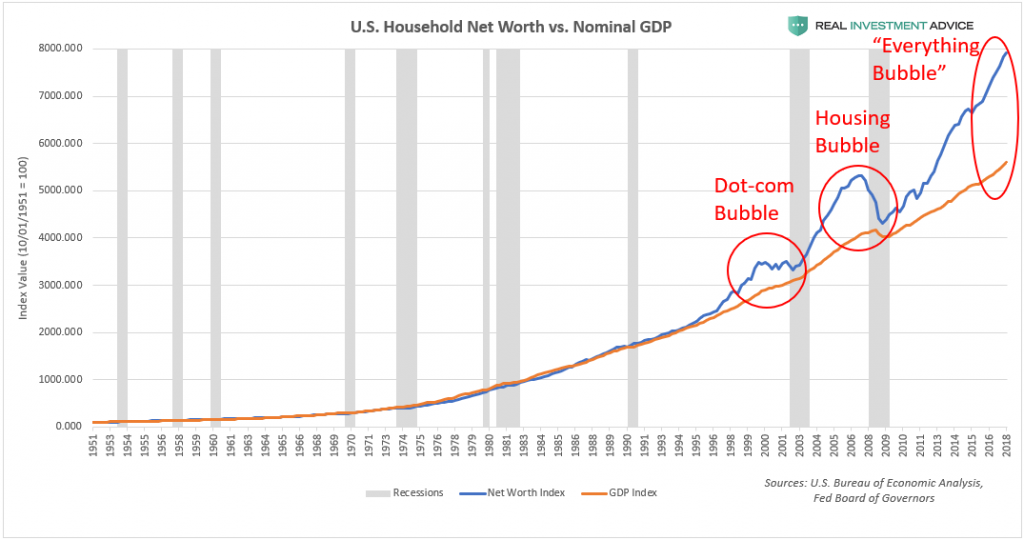
With cheap interest rates readily available, it has allowed ‘passive investors’ to enter the stock market. This has caused stocks to rise and prices to surge. It parallels the Federal Reserve attempts in 1995, where they felt compelled to oversupply the economy with near zero interest-rates; they believed this could enable strong economic growth in the future. The only thing it did enable was the dot-com crash of 2000 and the housing crash of 2007. As this present-day debt spirals, surely it won’t be long till we see the third major crash.

Looking beyond the US also makes for bleak reading. China is currently experiencing an explosive debt bomb, which has huge global implications. Similarly, with the debt and ongoing trade war between the two countries, it means that any sort of financial bailout looks increasingly improbable.

As I have seen from my previous blogs, this bubble is experiencing similar trends of the past. The term “history repeats itself” seems apt here to describe bubbles. Humans will always create bubbles through speculation and greed – cheap finance fuels this to the point where the government can no longer postpone the popping.
My take on bubbles? Widely inflated prices will always drop, the bubble will always burst and history will always repeat itself.

Rest assured the pop is coming and it certainly won’t be a pretty sight when it does….

Leave Us A Loan!

There’s a scene in the movie Orange County where the main character is desperate to be accepted into Stanford University “because that’s what you do after high school!” You can find a clip of the movie below:
https://www.youtube.com/watch?v=Qg4NBOIbwXc

Source:
Game of Loans: The Rhetoric and Reality of Student Debt

As I write this blog for one of my university modules, I am encouraged to consider my own motivations for attending further education after school. Often the choice is riddled with questions about the debt that would be involved, yet this is often debunked by the accessibility and convenience of student loans. However, as the number and value of student loans rise – it begs the question: is there a student loan bubble?

In the context of the USA, a paper by Grant and Anglin (2013) depicts the bleak outlook facing the country. They claim that the student loan debt is upwards of $1.2 trillion and is now the second largest form of consumer debt. Some scholars have compared it to the housing bubble of 2007-2008. More loans are being offered to the most vulnerable who will be unable to pay this back, as the prices continues to rise. Yet a key difference in that time was that homeowners could declare bankruptcy to alleviate this debt through the seizing of assets. Bankruptcy and student loans are seen as a no-go area. Scarily, it has been predicted that, by 2023, nearly 40% of borrowers will default on their student loan payments.

The Student Loan Crisis in the USA in comparison with the housing bubble and credit debt.

However there are claims that the bubble cannot burst. The repayment of student loans are collateral on earnings – as long as there is a potential to earn, it is unlikely that we will see a ‘pop,’ In extreme cases there is the option of clearing student debt through bankruptcy.

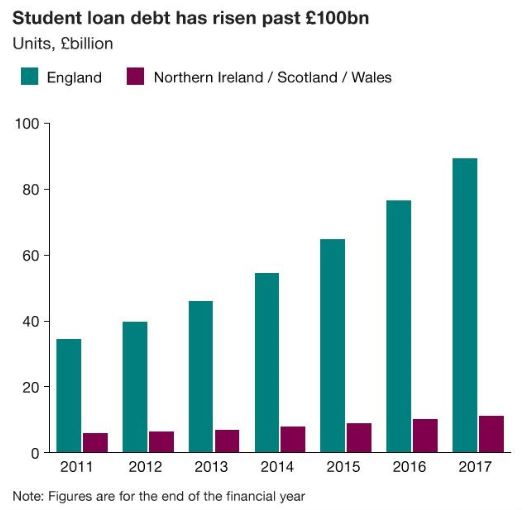
In the UK, similar problems have emerged. Student debt has reached over £100bn for the first time. Nick Hillman, director of HEPI, believes that the increase in debt directly correlates to the rising tuition fees, which have tripled since they were introduced in the UK over 20 years ago. As repayments only begin when the income threshold reaches £21,000 it means that people are exposed to this debt throughout their lifetime.

Source: Student Loans Company

There is no doubt, according to the figures, that there is an accelerating student debt crisis. In many ways it could be considered a speculative bubble – students are the ‘investors’ buying into these loans as it is seen as the normative to attend university or college.

While the bubble may not have burst yet, the government should monitor this situation closely as we may not be far off this debt spiraling beyond the realms of control.

Has the Bitcoin Bubble Burst?

To buy or not to buy? That is most definitely the question.

If you don’t follow the financial world, it’s hard to believe that cryptocurrencies have survived a decade, having launched in 2009.

Source: CoinDesk

Cryptocurrencies can be defined simply as a digital or virtual means of exchange which uses cryptography for security purposes. The first of these, and still the most popular today, is Bitcoin, which introduces us to today’s blog.

Rather than explaining the concept in depth you can find a crash course on Bitcoin in the video below:

The Bitcoin Bubble

With millions of internet searches, it’s hard to avoid the term ‘Bitcoin.’ From 2009 we have seen the interest and value of this digital currency rise. Incredibly, a 6 storey in Notting Hill mansion (valued at £17m) was on the market for 5050 Bitcoin only – a bargain, right?

The rise and fall in value of Bitcoin has been likened to the Tulip Mania (referred to in last week’s blog). In December 2017, Bitcoin peaked at $19,511 and later spectacularly collapsed, losing 82% of its value. It is for this reason, Bitcoin can be seen as a speculative investment, similar to internet stocks in the 1990’s, where it was difficult to traditionally value these modern technologies. The theory of social contagion by Robert Schiller aptly explains the Bitcoin bubble movement – early news of success stirred interest from other investors hoping to ride the wave; the bubble increased as prices rose.

Nouriel Roubini, who predicted the 2008 financial crisis, described the 2017 plummet (depicted in the left graph above) as the “mother of all bubbles.” The graph below depicts the dot-com crash and we can see a similar trend in comparison to the Bitcoin bubble.

However, that’s not to say that Bitcoin cannot regain or surpass its peak bubble value – in 2001 Amazon traded at under $6 per share yet managed to recover its peak value seven years later in 2007. Today it has a stock value of $1 trillion.

The dot-com bubble

Naturally there are people who dispute the notion of a Bitcoin bubble. It is suggested that this bubble has not burst as there was no rush to sell Bitcoin whenever prices dropped. Controversially, the CEO of Ambrosus Angel Versetti, has claimed that we are not even close to seeing a bubble with Bitcoin; he believes that it can only be considered a bubble when tokens reach 15-20 trillion USD.

It is uncertain what the future holds for Bitcoin and the world of cryptocurrencies but it is clear that Bitcoin has experienced numerous bubbles. While it may not have had the same impact as other major bubbles, when compared Bitcoin displays clear characteristics of a bubble.

Bitcoin is certainly not dead but only time will tell if it can stay the distance.

To buy or not to buy? I think I’ll avoid this one.

Living in a Bubble

You can be forgiven for forgetting Eiffel 65’s 1999 song ‘Living in a Bubble,’ yet the lyrics resonate aptly within the world of economic bubbles and provides the backdrop for this blog and the theme of ‘Bubble and Bleak.’

An extract of Eiffel 65’s ‘Living in a Bubble’.

What is a Bubble?
Essentially, a bubble is an economic cycle characterised by asset prices which fluctuate far beyond their inherent value. It is driven by exuberant market behavior and is typically followed by a collapse and widespread panic (Allen and Gale, 2000). White (2010) believes the identification of a bubble is simple: asset prices will go up and then back down again rapidly.

“where investors buy an asset not for its fundamental value, but because they plan to resell, at a higher price, to the next investor “


Peter Koudiji of Stanford University defines a bubble

Tulipomania
The easiest place to start with bubbles is at the beginning – 1637 to be precise. ‘Tulip mania’ has been widely regarded as the earliest recording of a financial bubble. During this time the tulip dramatically rose in popularity in the Netherlands and the tulip market became a crucial part of the booming Dutch economy ( Colombo, 2012). As speculators began to trade the tulips for profit, their price escalated. Naturally, this became unsustainable as more people purchased tulips. At the time, it was reported that the average price of the flowers exceeded the annual income of skilled workers and even some houses. Tulip holders instantly became bankrupted as the economy collapsed.

Source: Jesse Colombo

However, recently, many scholars have speculated that this was not a ‘real’ bubble and merely fiction. Thompson (2007) believes that this event did not meet the fundamentals of a bubble and was simply a period were future contracts were converted into option exercise prices. While this may be the case, the tulip mania provides a practical description of a bubble bursting and an important introduction to the blog.

Bibliography
Allen, F. and Gale, D. (2000). Financial Contagion. Journal of Political Economy, 108(1), 1-33.

Colombo, J. (2012). The Dutch “Tulip Mania” Bubble (aka “Tulipomania”). Available at: http://www.thebubblebubble.com/tulip-mania/ [Accessed 4 Feb. 2019].

Thompson, E. A. (2007). The Tulipmania: Fact or Artifact?. Public Choice, 130 (1–2), 99–114.

White, L.J. (2010). Preventing Bubbles: What Role for Financial Regulation? Stern School of Business, New York University.